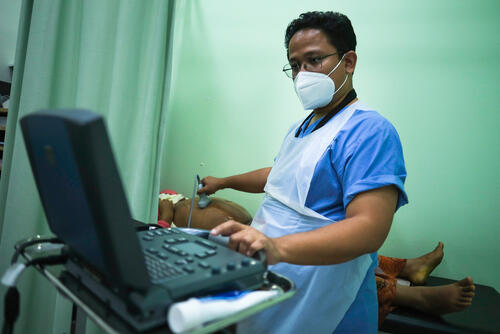
Patients, most of whom are from the Rohingya community, queue up for triaging at the MSF clinic in Butterworth, Penang.
Patients, most of whom are from the Rohingya community, queue up for triaging at the MSF clinic in Butterworth, Penang, Malaysia, May 2022.
© Kit Chan

Our teams provide general healthcare and mental health support to refugees in urban settings and detention centres. We also refer patients for specialised healthcare.

Our activities in 2025 in Malaysia

Data and information from the International Activity Report 2025.

MSF in Malaysia in 2025 In Malaysia, Médecins Sans Frontières (MSF) assists refugees, primarily the Rohingya community, who face systemic barriers to healthcare.
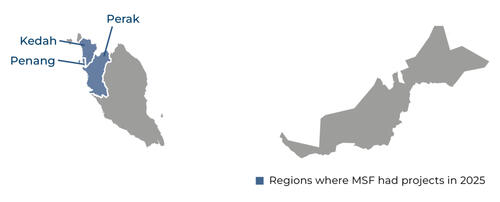
Country map for the IAR 2025.
© MSF

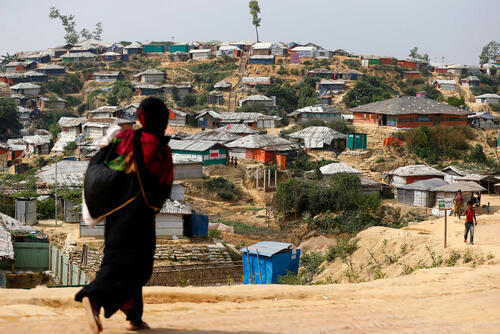
Between January and October 2025, over 5,100 Rohingya refugees undertook dangerous sea and river crossings – navigating the Naf River, the Bay of Bengal, and the Andaman Sea.* The Malaysian coastguard routinely intercepted and pushed boats back, capsizing them, or forcing them to return to Myanmar or Bangladesh. The Rohingya community in Malaysia has grown from approximately 5,000 in the 1990s to more than 200,000 today,** reflecting decades of persecution and displacement.  

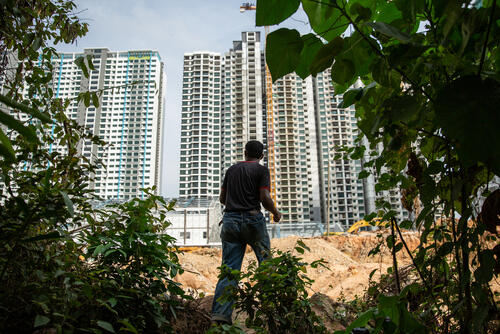
Malaysia's non-signatory status to the 1951 Refugee Convention leaves this community exposed to immigration raids, arbitrary arrest, prolonged detention, discrimination, and deportation. While the government has taken steps to transfer detained mothers and children from immigration detention centres (IDCs) to dedicated facilities, sustainable and humane alternatives to detention have yet to be established.  

We reach the most vulnerable – women and children without a registration card from UNHCR, the UN refugee agency – through a fixed clinic in Butterworth, Penang, and six mobile clinics across Penang and Kedah. Our services include general healthcare, treatment for sexual and gender-based violence, mental health support, health awareness sessions, routine vaccinations for children, and specialist referrals to other facilities. We also refer patients to UNHCR, where registration enables access to healthcare at reduced cost. Demand for antenatal care and family planning remains consistently high.  

In two IDCs in Kedah and Perak, we provide medical and psychosocial care, distribute essential hygiene items, including soap and sanitary pads, and conduct training for immigration officers and medical assistants on medical and mental health issues. 

Advocacy at state and federal levels remains central to MSF’s work in Malaysia. We continue to oppose the detention of refugees in IDCs, and call for refugees to be issued identity documents, enabling them to work, access healthcare, and be better protected from exploitation and discrimination.


*IOM: https://dtm.iom.int/sites/g/files/tmzbdl1461/files/reports/RDH_RBA_Factsheet_Intraregional_2025.pdf?iframe=true
**Lowy Institute: https://www.lowyinstitute.org/the-interpreter/rohingya-boats-out-mind-still-coming
 
In 2025

Malaysia

Language
English