
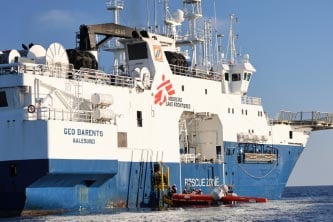
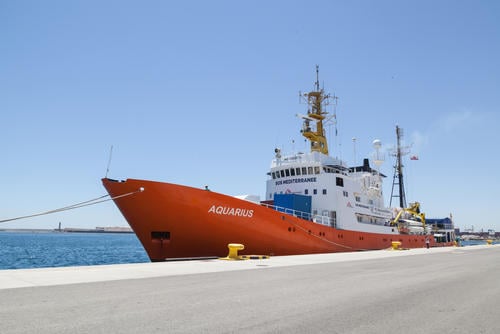
Amsterdam – Médecins Sans Frontières (MSF) welcomes the ruling earlier this week by the court of Catania in Italy to dismiss allegations related to the management of onboard waste on the search and rescue vessel Aquarius. It operated in the central Mediterranean from 2016 to 2018.
After a long investigation and trial, the criminal court of Catania ascertained that all activities connected to the Aquarius, including port procedures and waste disposal, complied with regulations. These legal proceedings had a profound impact on the staff involved, and impacted lifesaving search and rescue operations at sea.
This ruling is an important moment of recognition for the teams who worked under intense political pressure while trying to save lives on the world’s deadliest migration route.Paul Brockmann, MSF Operational Manager
“It marks an important step away from the unfounded criminalisation of search and rescue efforts at sea,” he added.
Over the course of this case, attacks against civilian search and rescue operations continued and escalated. MSF staff remain on trial in Catania over similar waste management allegations concerning another boat, the Vos Prudence. We are confident this decision will contribute to a positive outcome in the related case as well.
People continue to flee violence, exploitation, insecurity, and extreme hardship. Many still risk their lives attempting sea crossings in search of safety or asylum. In the central Mediterranean, MSF witnesses the humanitarian catastrophe caused by insufficient state-led search and rescue capacity, and harmful European migration policies. These failures leave people to die at sea or be forcibly returned to violence, arbitrary detention in inhumane conditions, and abuse.
Over the years, European states, Italy in particular, have intensified restrictive policies, administrative obstacles, vessel detentions, and legal actions targeting humanitarian organisations operating at sea. This has had devastating consequences for people who attempt to cross the Mediterranean Sea.
The start of 2026 saw a dramatic increase in deaths and disappearances at sea, with at least 655 people reported dead or missing between January and February. This is more than double the number recorded during the same period in 2025. By the end of June 2026, over 1,400 people were feared dead or missing in the Mediterranean.1, 2
We reiterate our call to Italian authorities and EU member states to stop obstructing civilian search and rescue operations. They must also guarantee timely disembarkation in safe ports, establish adequate EU-led search and rescue capacity, and place the protection of human life and dignity at the centre of migration policies.
MSF teams first began search and rescue operations in the Mediterranean Sea in 2015, to fill the void left by the closure of the Italian Government Mare Nostrum rescue operation. Since then, 9 different MSF ships, (alone or in partnership with other NGOs), have helped to save more than 94,200 lives in the Central Mediterranean Sea. This includes the Aquarius which operated between 2016 and 2018, rescuing nearly 30,000 people. Despite barriers, MSF teams maintain a strong commitment to being present in the Central Mediterranean, and teams are preparing the next rescue operations onboard our current vessel, Oyvon.
Gaza-Israel war
Testimony from an injured MSF colleague in Gaza, Palestine
Voices from the Field
17 Jul 2026
Natural hazards
People needing mental and medical help one month after the earthquakes in Venezuela
Project Update
24 Jul 2026
Mauritania
Urgent measures needed to prevent further deaths on deadly Atlantic migration route
Press Release
23 Jul 2026